How Currency Exchange Rates Work: A Plain-English Guide
Understand what exchange rates are, what drives them, how central banks influence them, and how bid/ask spreads affect the rate you actually get.
- exchange rates
- currency basics
- forex
- central banks
- financial literacy

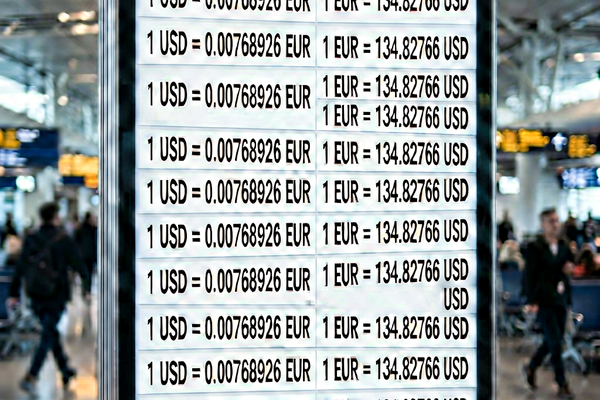
An exchange rate tells you one simple thing: how much of one currency you receive in exchange for one unit of another. If the USD/EUR rate is 0.92, you get 0.92 euros for every US dollar you hand over. That single number connects economies, shapes trade flows, and determines how far your money goes when you travel or send funds abroad.
Understanding how that number is set — and why it changes — helps you make smarter decisions every time you deal with foreign currency.
What Is an Exchange Rate, Exactly?
Every exchange rate is a price. Like the price of a loaf of bread, it represents the agreed value between a buyer and a seller at a particular moment. When you see “1 USD = 0.92 EUR,” that is the price of one US dollar expressed in euros.
Rates are quoted in two common ways:
- Direct quotation: The domestic currency is the “price” currency. For a US-based person, USD/EUR = 0.92 means one dollar buys 0.92 euros.
- Indirect quotation: The domestic currency is the “base” currency. EUR/USD = 1.09 means one euro buys 1.09 dollars.
The same relationship, shown from two different angles. Confusingly, conventions differ by country and by market convention — EUR/USD is always quoted with the euro as the base currency regardless of where you are, because that is how the professional FX market standardized it.
Three Types of Exchange Rate Systems
Countries do not all manage their currencies the same way. There are three broad systems:
Floating Exchange Rates
Most major currencies — the US dollar, euro, British pound, Japanese yen — operate under a floating (or “free-floating”) system. Their rates are determined by supply and demand in the global foreign exchange market, which the Bank for International Settlements (BIS) estimates trades over $7 trillion per day. No single authority sets the rate; it emerges from millions of transactions.
Fixed (Pegged) Exchange Rates
Some countries peg their currency to another, usually the US dollar or a basket of currencies. The Emirati dirham, for example, has been pegged to the US dollar since 1997 at approximately 3.67 AED per USD. The central bank maintains this rate by buying or selling its own currency and foreign reserves as needed.
Managed Float (Dirty Float)
Many countries fall between the extremes. Their currencies float in principle but their central banks intervene occasionally to smooth out excessive volatility or prevent their currency from moving in ways that would harm the economy. China’s renminbi is a well-known example of a managed float system.
What Drives Floating Exchange Rates?
If you want to understand why a currency rises or falls, you need to understand what drives demand for it.
Supply and Demand
At the most basic level, a currency becomes more valuable when more people want it. If US exports are in high demand, foreign buyers need dollars to pay for them — that demand strengthens the dollar. If investors want to buy US stocks or Treasury bonds, they also need dollars first.
Trade Flows
A country that exports more than it imports tends to see stronger demand for its currency, because trading partners must acquire that currency to pay for goods. A persistent trade surplus can support a stronger currency over time.
Inflation Differentials
If one country has higher inflation than another, its currency tends to weaken over time. Higher inflation erodes purchasing power. The Federal Reserve and the European Central Bank (ECB) both have explicit mandates tied to price stability — partly because inflation management is so closely connected to currency value.
Interest Rates
Interest rates are one of the most powerful short-term drivers. When a central bank raises rates, it offers higher returns on deposits and bonds denominated in that currency. Global investors move capital toward higher-yielding currencies, increasing demand and pushing the exchange rate up. This is why Federal Reserve rate decisions and ECB rate decisions move the EUR/USD pair immediately.
Market Sentiment
Currency markets are also driven by expectation and sentiment. If traders believe the US economy is about to slow down, they may sell dollars preemptively, weakening the rate even before any economic data confirms it. Sentiment can be a powerful short-term driver that temporarily overrides fundamental factors.
The Role of Central Banks
Central banks do not set exchange rates under a floating system, but they influence them in several ways:
- Setting interest rates: As described above, rate decisions directly affect capital flows.
- Forward guidance: Statements from the Federal Reserve or ECB about future policy move markets before any policy change happens.
- Direct intervention: In extreme cases, a central bank may buy or sell its own currency in the open market to slow a rapid move. Japan’s Ministry of Finance, coordinating with the Bank of Japan, has intervened in yen markets multiple times in recent decades.
- Publishing reference rates: The ECB publishes daily euro foreign exchange reference rates. The Federal Reserve publishes the H.10 release of foreign exchange rates. These are benchmark rates used for accounting and reporting, not rates you can transact at directly.
Bid, Ask, and the Spread
Here is a detail that matters every time you exchange currency: there is never just one rate. There are two.
- Bid price: The rate at which the market (or bank, or exchange bureau) will buy the foreign currency from you.
- Ask price: The rate at which the market will sell the foreign currency to you.
The bid is always lower than the ask. The difference between them is called the spread, and it is how currency dealers make money. A tighter spread means a better deal for you; a wider spread means more profit for the dealer.
At the interbank level — where large institutions trade with each other — spreads on major currency pairs can be a fraction of a cent. By the time that rate reaches a retail customer at a bank branch or airport kiosk, the spread widens considerably, and the dealer may add an explicit fee on top.
When you see a quoted exchange rate on a general news site or financial app, you are usually seeing the mid-market rate — the midpoint between bid and ask. This is the “true” rate in an economic sense, but it is not a rate most retail customers can actually access.
Putting It Together
Exchange rates are the result of a continuous, global auction. Supply and demand interact in real time, shaped by trade, investment, inflation, interest rate differentials, geopolitical events, and the expectations of millions of market participants. Central banks like the Federal Reserve and the ECB play an important role — not by dictating rates, but by setting the conditions that influence where rates move.
When you use a currency converter, the rate you see reflects the mid-market rate at that moment. The rate you actually transact at will depend on where you exchange — and that difference, the spread plus any fees, is worth understanding before you hand over your money.
Exchange rates shown are for informational purposes only and may differ from rates offered by banks, money transfer services, or foreign exchange providers. Always verify current rates before completing any financial transaction.
Related reading
-
Bank Exchange Rate vs Market Rate: Why They're Different
Learn why the rate your bank offers is always worse than the market rate, how the margin works, and which venues give you the best deal on currency exchange.
-
Best Time to Exchange Currency: What Actually Matters
Honest advice on when to exchange currency — what you can control, what you cannot, and how to avoid the biggest costs regardless of timing.
-
USD to EUR: Understanding the World's Most-Traded Currency Pair
Learn what drives the USD/EUR exchange rate, the history of the euro, how to read the pair, and what to know about converting dollars to euros today.